The most sustainable move is the one that carries less, packs in containers that get used again and again, and makes as few trips as possible. In practice that means four habits: clear out before you pack, use what you already own, swap single-use cardboard for reusable boxes, and deal with whatever is left over through the right Irish disposal route. At Moving Box Rental we deliver reusable 100L plastic boxes with secure lids and collect them when you are done, so there is nothing to assemble, tape or recycle afterwards.
This guide takes you through the move in the order you will actually do it, with Irish sources for the rules on donating, recycling and disposal.
Key Takeaways
- Every item you do not move saves packing materials, van space and fuel, so declutter room by room before you buy or book anything.
- Suitcases, laundry baskets, bags and blankets can carry and cushion a good share of your belongings at no cost.
- Reusable boxes replace a pile of cardboard and tape with containers that are delivered, used and collected.
- Use Irish routes for what you do not keep: charity, resale, the dry recycling bin and your local civic amenity site.
- Fewer, fuller trips beat many half-empty ones, whether you drive yourself or hire help.
Table of Contents
- Why the sustainable part of a move starts before packing
- Start early and clear out room by room
- Use what you already own
- Choose packing materials that do not become waste
- Reusable boxes: how rental fits a low-waste move
- Pack in a way that cuts trips and damage
- After the move: return, reuse, recycle
- Promo: reusable boxes for your next move
- Our view: the greenest box is the one that gets used again
- FAQ
- Sources
Why the sustainable part of a move starts before packing
Most of the environmental cost of a move is decided by how much you take. Every extra bookshelf, bag of old clothes or box of cables you carry needs packing materials, space in a vehicle and, often, more journeys. The David Suzuki Foundation’s green moving guide makes the same point: reduce the load first, because fewer belongings mean fewer packing materials, a smaller vehicle and fewer trips. The guide is international rather than Irish, but the logic holds anywhere.
So the first sustainable decision is not which box to choose. It is what you are going to put in it.
Start early and clear out room by room
Give yourself weeks, not days. Rushed clear-outs end in skips, because there is no time to find a charity that will take the sofa or to sell the bookcase. Starting early also lets you use up the food in your freezer and cupboards rather than carrying it or binning it.
The South West Region Waste Management Office’s Circular Guide to Clear Outs (2025) recommends working through your home room by room and sorting everything into six groups, and says this applies when you move house too:
- Keep: what you will genuinely use in the new home.
- Reuse: what you can repurpose yourself, for example as packing material.
- Donate: usable items for friends, family or charity.
- Sell: anything with real resale value.
- Recycle: items accepted in the dry recycling bin or at a civic amenity site.
- Dispose: only what cannot go anywhere else, through authorised routes.
A civic amenity site is the local authority recycling centre, often called “the dump” or “the recycling centre”. Do the clear-out one room at a time, as the Irish Times also advises, so that you finish each room rather than starting ten piles.
Where unwanted items should go in Ireland
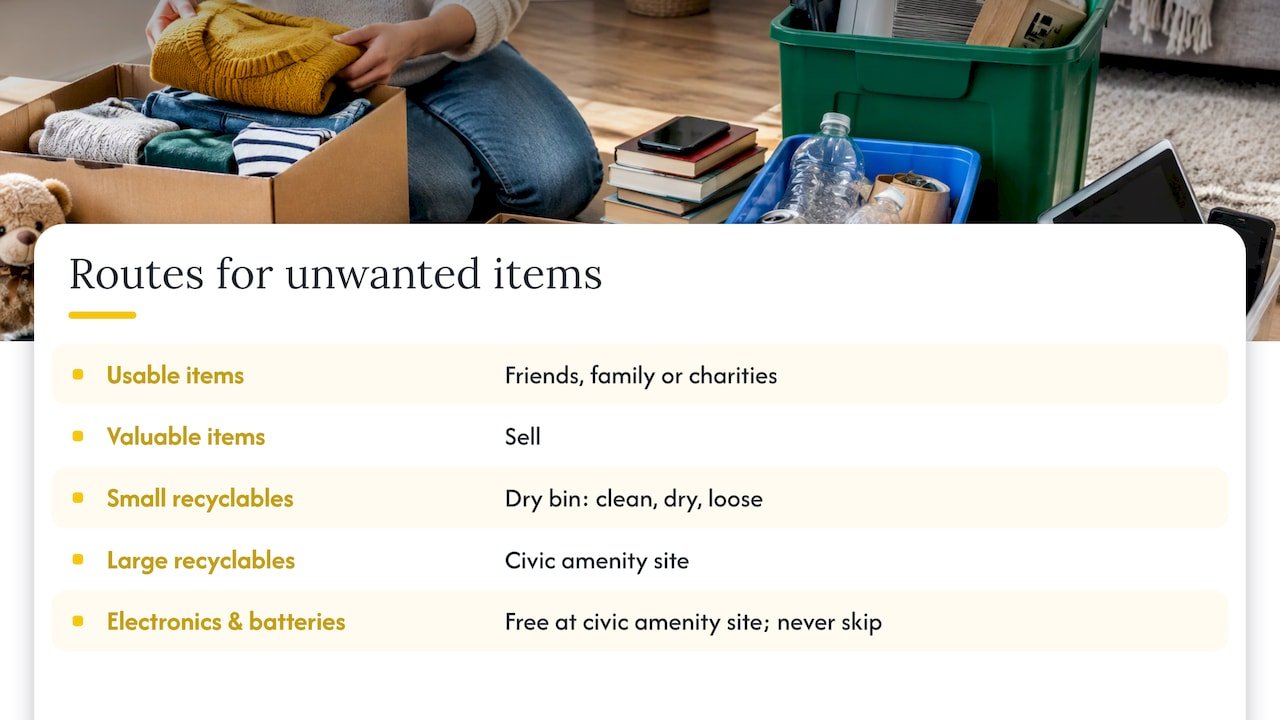
The same Circular Guide sets out the routes. Usable items can go to friends, family or charities, and valuable items can be sold. It names kitchen cabinets, counters, doors and fireplaces as examples of things people forget are reusable. Small recyclable materials go into the dry recycling bin clean, dry and loose, and larger recyclables go to a civic amenity site.
For furniture, MyWaste’s large-items guidance says usable pieces may be donated to a local charity, and that some charities collect. It also advises donating only what is suitable for resale, so that a charity is not left paying to dispose of it. Bulky furniture, mattresses and old fitness or play equipment can be recycled by special arrangement, and it is worth checking whether your local authority runs a fee-based bulky-goods collection.
The Irish Times reports that electrical items, batteries and battery-powered items can be recycled free at a local civic amenity site and should not go in a skip. Old chargers, kettles and toys with batteries are the usual culprits in a move.
A worked example
Take a family leaving a three-bed house. In the kids’ room they find outgrown clothes (donate), a working toy kitchen (sell), a broken light-up toy (battery and electrical recycling at the civic amenity site) and a bag of paper scraps (dry recycling). The living room yields a spare bookcase that a neighbour wants. None of that goes in a box or on the van. By the end of the week they have probably removed several boxes’ worth of belongings, and every box not packed is one less to buy, carry and get rid of.
Ireland has room to improve here. The EPA’s circular economy progress page reports a reuse rate of 15.5 kg per person per year in 2024, against a target above 20 kg per person by 2030. A move is one of the few moments when a household handles almost everything it owns, which makes it a good time to put more of it back into use.
If you are also pacing your packing around a pregnancy, a practical plan for moving house during pregnancy shows how spreading the work over several weeks keeps the lifting manageable, and that same slower pace is what lets you sort and rehome things properly instead of binning them.
Use what you already own
Before buying anything, look around the house. You already own a lot of containers and cushioning:
- Suitcases, holdalls and gym bags carry clothes and shoes.
- Laundry baskets and drawer units can be moved with their contents in place.
- Reusable shopping bags suit soft or light items.
- Towels, blankets, bedding and jumpers wrap fragile items such as glasses and framed pictures, replacing plastic bubble wrap with things you were going to move anyway.
The benefit is double. You avoid buying single-use packaging, and the wrapping materials arrive at the new house already clean and ready to put away. Pack the soft items first so they are on hand to protect the breakables later.
There is a limit, though. Suitcases and baskets are awkward to stack, and they are not the same size, so they waste van space. That is where a consistent set of boxes earns its place.
Choose packing materials that do not become waste
The usual answer to “what should I pack in?” is cardboard, and cardboard is recyclable. But recyclable is not the same as low-waste. Moving boxes typically need folding, taping and labelling, and when you finish unpacking you are left with a heap of flattened board, tape that should be peeled off, and a trip to the recycling bin.
The EPA reports Ireland’s municipal waste recycling rate at 43% in 2024, with a 2030 target above 60%. Material that is reused sits above recycling in the usual waste hierarchy, because it needs no reprocessing at all. A box that is used for ten moves beats a box that is recycled after one.
Here is how the main options compare for a typical house move:
| Option | Assembly or tape | Stacks evenly | What is left afterwards |
|---|---|---|---|
| Cardboard boxes, new | Yes | Yes, until they sag | Flattened board to recycle |
| Cardboard boxes, second-hand | Yes | Depends on condition | Board to recycle sooner |
| Bags, baskets and suitcases | No | No | Nothing, you keep them |
| Rented reusable 100L plastic boxes | No | Yes, with secure lids | Nothing, they are collected |
A mix usually works best: your own suitcases and baskets for soft items and awkward shapes, and a set of reusable boxes for the bulk of the packing.
Reusable boxes: how rental fits a low-waste move
Buying plastic boxes you will use once is not sustainable. Renting boxes that are designed to be used over and over is a different thing: the same container serves move after move, and you keep nothing you do not need.
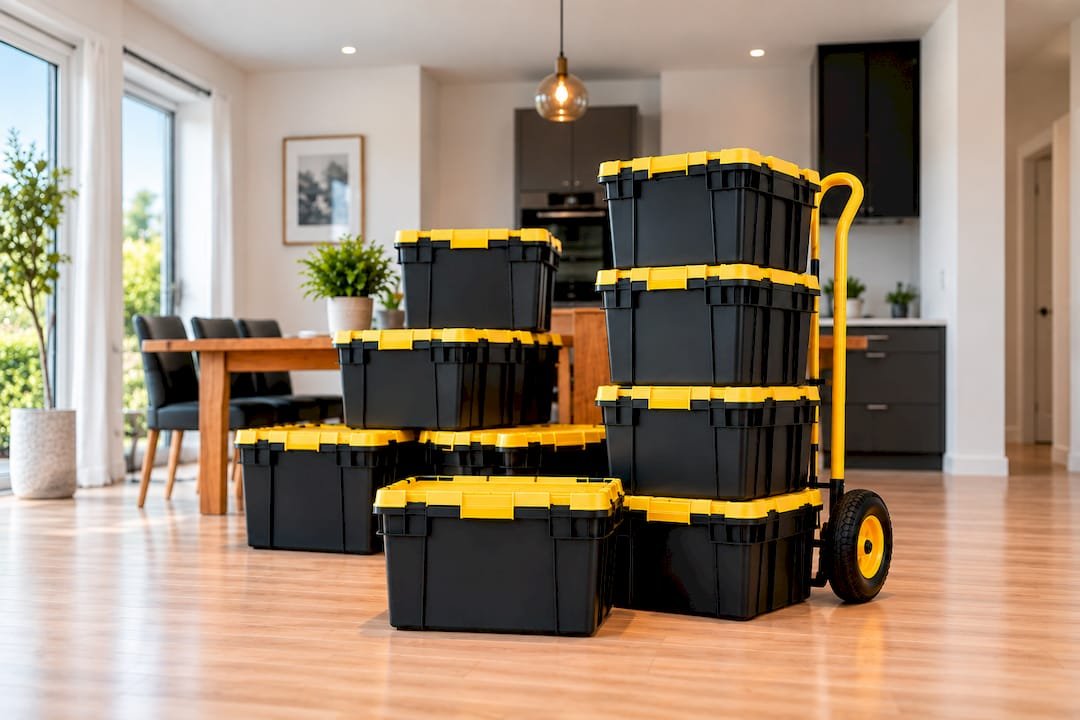
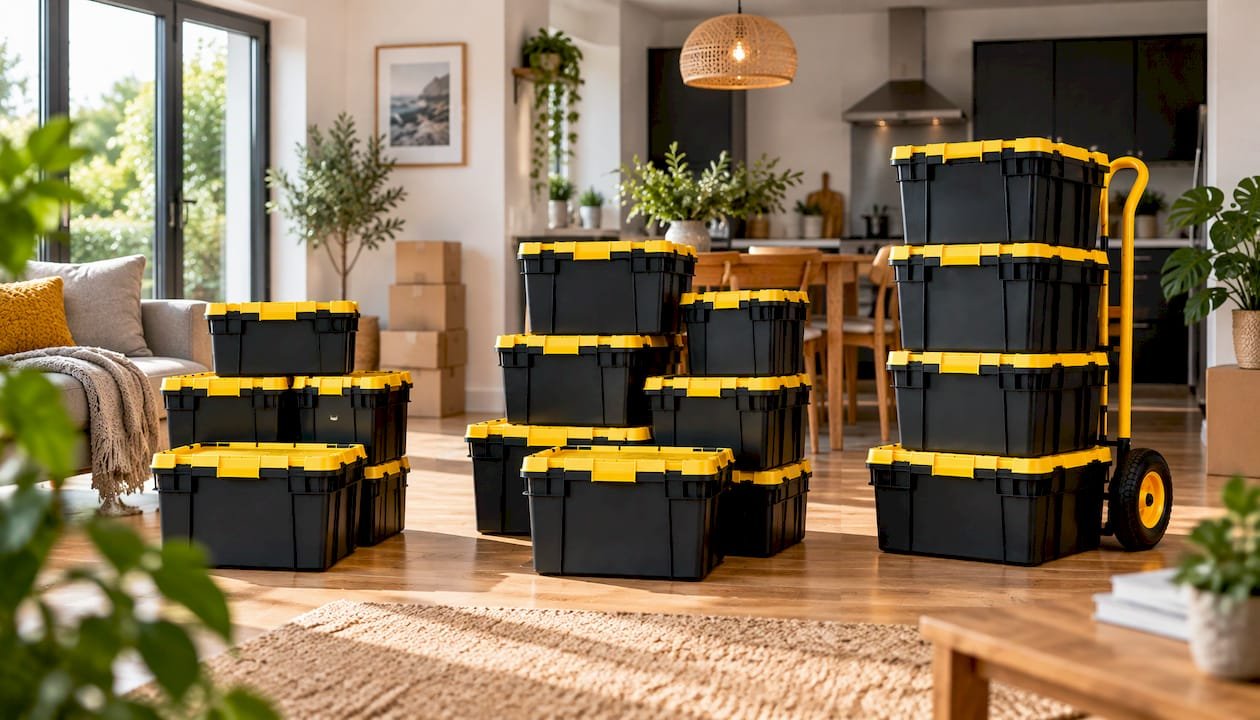
This is how our service works. We rent strong, reusable 100L plastic moving boxes with secure lids. We deliver them to your home and collect them afterwards, with free delivery and collection within our specified areas. The boxes arrive ready to use, with no assembly and no packing tape. Each package includes a moving trolley, and you choose a rental period of one to four weeks.
Here is how that maps onto the habits in this guide:
- No tape, no flattening. Lids close securely, so there is no tape to peel and no board to break down.
- A defined end date. A one to four week rental gives you a clear window to pack, move and unpack, and the boxes leave with the collection.
- A moving trolley in the package. It lets you move several boxes in one go, which makes loading faster and helps you keep the trips down.
- Uniform boxes. Matching boxes stack neatly, which helps you fill a van properly.
How many boxes do you need?
Our packages come in sets of 10, 15, 20 and 25 boxes. The right number depends on the size of the home and how much you cleared out first, which is another reason to declutter early. Our room-by-room guide to how many boxes you need for moving house walks through it, and you can see the full range on our moving boxes page.
For students and short-term storage
Students moving between term-time accommodation and home often need a few boxes for a few weeks. The same logic applies: rent what you need for the length of time you need it, and hand it back. Sorting your things first, as above, keeps the number of boxes down.
Pack in a way that cuts trips and damage
How you pack changes how many journeys you make.
- Fill each box properly. Put heavy items such as books at the bottom of a box and lighter items above. A 100L box is large, so keep heavy things in smaller amounts so it stays liftable.
- Fill gaps with soft items. Towels and clothes stop glasses and ornaments rattling, so you do not need bubble wrap.
- Label by room. Write the destination room on the box so it goes straight to the right place and you do not move things twice.
- Load in one go if you can. The Suzuki guide recommends consolidating the load and, if you use your own vehicle, avoiding peak times. Two full journeys use less fuel than four half-empty ones.
- Choose the vehicle to match the load. The smaller the load after your clear-out, the smaller the vehicle you need.
If you are hiring a van or a removals firm, ask about the vehicle and whether the route can be combined with other stops. Doing the packing yourself with ready-to-use boxes also means the van arrives to a finished job and is not waiting while you tape the last boxes.
After the move: return, reuse, recycle
The end of the move is where waste normally appears, so plan it on the first day.
- Return rented items promptly. The Suzuki guide advises returning rented bins and borrowed gear quickly so others can use them. With us, collection is arranged as part of the package, so unpack and have the boxes ready for the end of your rental period.
- Rehome leftovers. Spare packing materials, wrapping blankets you no longer need and extra boxes can go to a neighbour, friend or someone moving soon.
- Recycle what is left properly. Flatten unusable cardboard and remove non-recyclable tape or labels first, as the Suzuki guide suggests. Keep recyclables clean, dry and loose in the dry recycling bin, as the Circular Guide says.
- Take electricals and batteries to the civic amenity site. Do not leave them in a skip.
Then look at the new home. Hanging washing outside to dry, switching to efficient lighting and planning a simple waste routine in the first week all stick best when you set them up while the house is still half unpacked.
Promo: reusable boxes for your next move
If you want to move without cardboard, tape or flat-pack clutter, our reusable 100L boxes come with a moving trolley, delivery and collection, and a one to four week rental. Choose a package of 10, 15, 20 or 25 boxes on our shop page, or see the 10 Moving Box Rental Package if you are moving a flat or a few rooms.
For an office, we also rent storage boxes by the month, with flexible quantities and replacements for damaged boxes: Small Office at €5 per month, Office at €9 per month, Business at €16 per month and Business Plus at €28 per month. The details are on our business storage box rental page.
Our view: the greenest box is the one that gets used again
We started Moving Box Rental because we saw what a house move leaves behind: stacks of flattened cardboard, rolls of tape and a recycling bin full by the second day. None of it is a mistake by the person moving. It is simply how single-use packing works.
Our answer is to make the box a service rather than a purchase. A strong 100L box with a secure lid comes to your door, does its job over one to four weeks, and goes back out on the next move. There is nothing to assemble and no tape to use, and with the moving trolley in the package, moving the boxes is easier too.
The best advice we can give is to combine the two ideas in this guide. Clear out first, using the donate, sell and recycle routes available in Ireland, so you pack less. Then pack what remains in containers that are built to be reused. That is a move you can feel good about, and it is also simply less work.
Vincent
FAQ
How do I make my move more eco-friendly on a budget?
Start with what you own: suitcases, laundry baskets, bags and towels cost nothing and cover a lot of packing. Clear out first so you carry less, and sell what has value. For the bulk of your belongings, a short rental of reusable boxes avoids buying materials you will throw away.
What can I do with moving boxes after the move?
With reusable rented boxes, you simply hand them back for collection. If you have used cardboard, flatten it, remove tape and labels, and put it in your dry recycling bin clean and dry. Spare boxes in good condition can also go to someone else who is about to move.
Where can I take unwanted furniture and electricals in Ireland?
Donate usable furniture to a local charity, and check first whether it can be resold. For bulky items such as mattresses, ask your local authority about a fee-based bulky-goods collection. Electrical items and batteries can go free to your local civic amenity site, according to the Irish Times.
How far ahead should I start planning a sustainable move?
Allow several weeks. That is enough time to go through each room, find the right home for unwanted items, use up food and book your boxes. Last-minute moves are where most waste and skip use happen.
Sources
- Circular Guide to Clear Outs, South West Region Waste Management Office (2025)
- Could you upcycle or reuse large items? MyWaste
- Ireland’s Progress to Circular Economy Targets, EPA
- Thinking about a clear out? Don’t just chuck everything in a skip, The Irish Times (5 January 2026)
- Green moving guide, David Suzuki Foundation
Leave a Reply