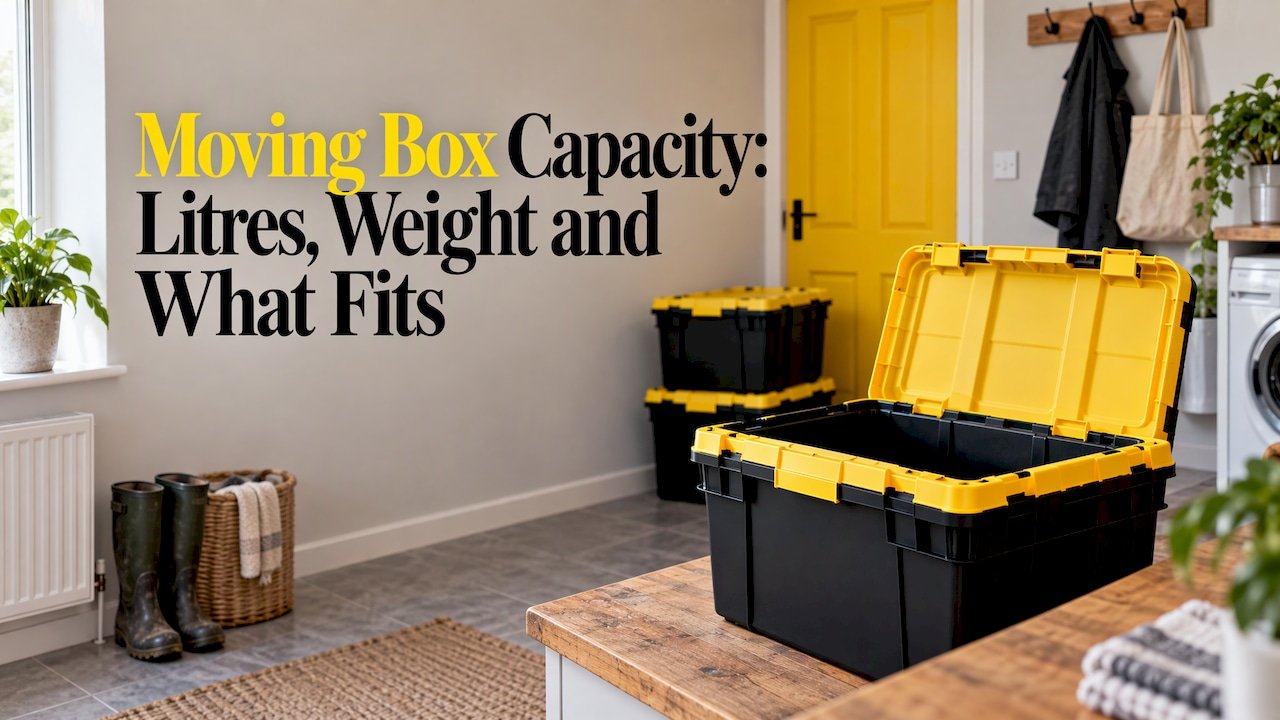
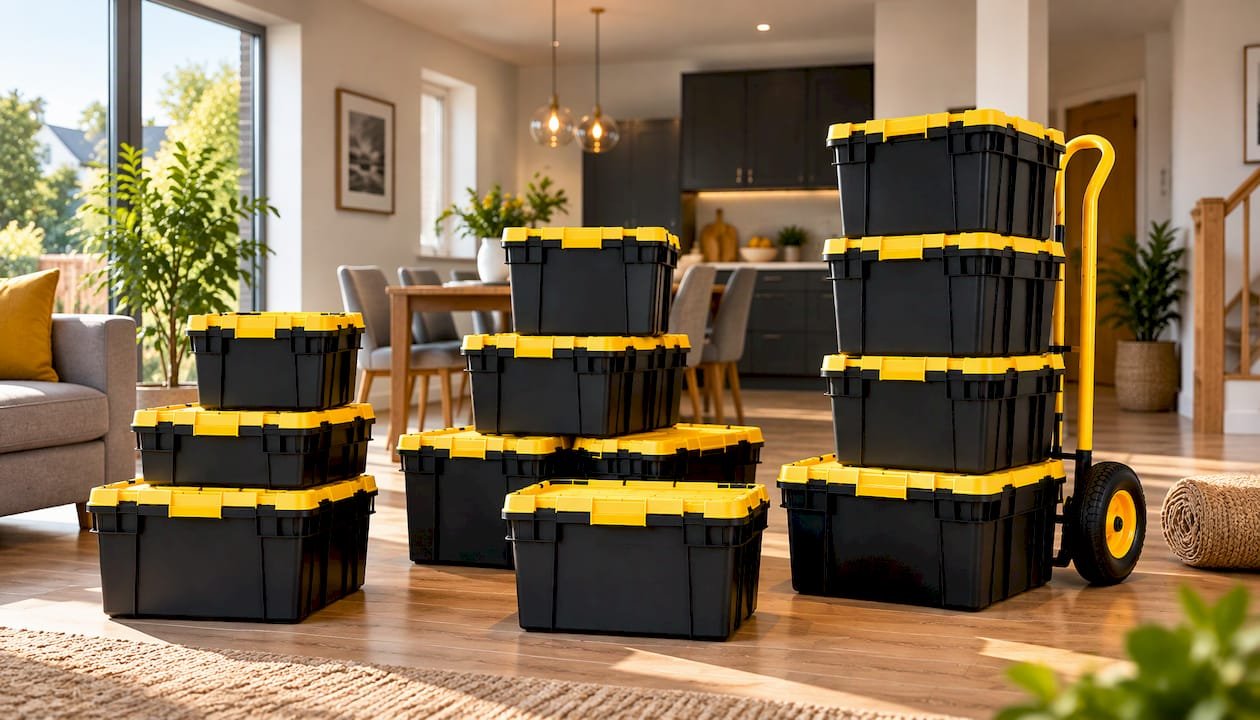
A moving box has two capacities: the volume it holds, measured in litres, and the weight you can safely lift once it is full. Volume tells you how many boxes you need. Weight tells you how to fill them. Our reusable boxes hold 100 litres each, with secure lids, and they arrive ready to use with no assembly or tape. This guide shows how to read a box’s capacity and fill it so it stays liftable on the stairs.
Key Takeaways
- Capacity is internal volume: length × width × height in centimetres, divided by 1,000, gives litres.
- Volume and weight are separate. A big box can hold far more than you can comfortably carry, so fill by weight as well as space.
- Pack heavy items low and in small amounts, and use the extra space for light, bulky things such as bedding, cushions and clothes.
- A 100L box is a large box. Fill it with light bulky items and mix heavy items in only as a base layer.
- Ready-to-use reusable boxes remove assembly and waste, and the package includes a moving trolley.
Table of Contents
- What box capacity actually means
- Common box sizes in litres
- Why weight matters more than volume
- How to work out how many boxes you need
- Stacking and carrying
- Why renting 100L boxes suits a house move
- Our view on box size
- Choose your package
- FAQ
- Sources
What box capacity actually means
Capacity is the space inside a box. Manufacturers and retailers state it in litres, which is the same unit as a milk carton or a bottle of water. One litre equals 1,000 cubic centimetres.
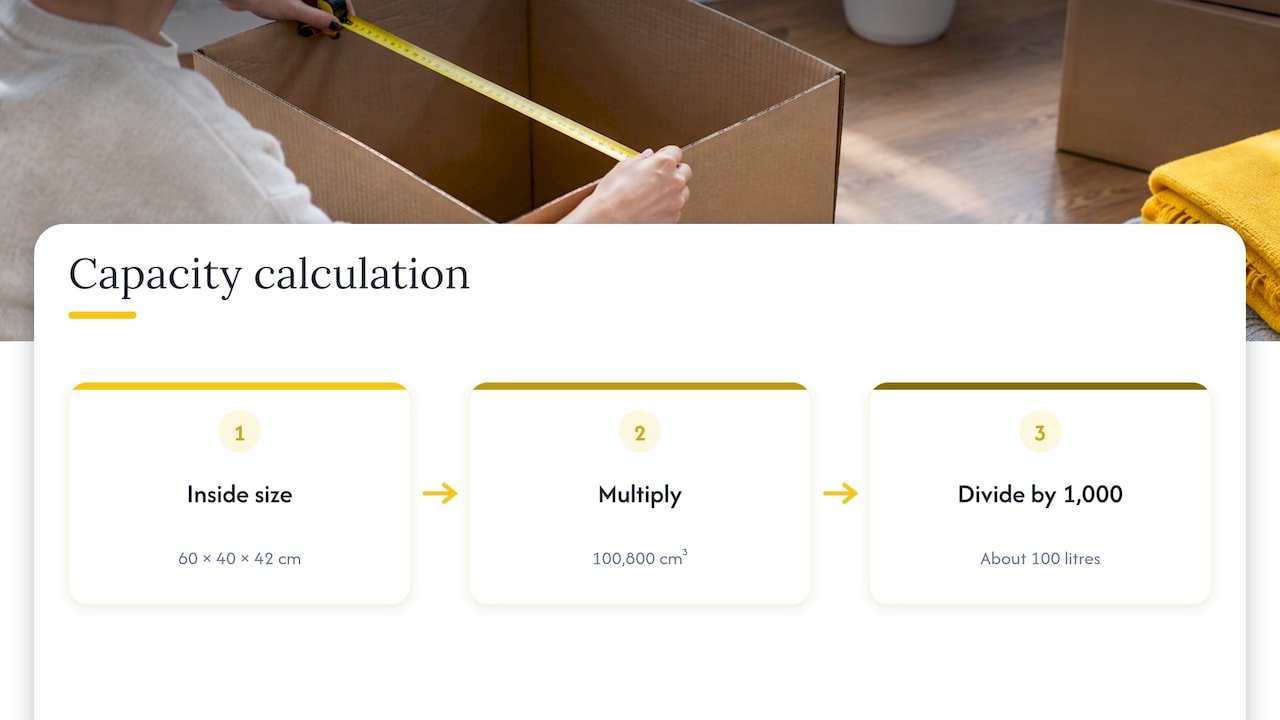
The calculation is simple. Measure the inside length, width and height in centimetres, multiply them, then divide by 1,000. A box measuring 300 × 200 × 150 mm works out at 9 litres, and the same source stresses using internal measurements, because external sizes include the thickness of the walls and overstate the usable space.
A worked example: a box with an inside length of 60 cm, width of 40 cm and height of 42 cm gives 60 × 40 × 42 = 100,800 cm³. Divide by 1,000 and you get about 100 litres. That is the size class of the boxes we rent.
If you like to see how volume and dimensions relate across much larger containers, this dumpster sizes and dimensions guide uses the same logic with bigger numbers.
Common box sizes in litres
Box sizes vary between suppliers, so it helps to know the range. One volume table lists a 40 × 30 × 30 cm box at 36 litres for books and heavy items, 50 × 35 × 35 cm at 61 litres for general use, and 60 × 40 × 40 cm at 96 litres for clothes and light items.
Irish removal firms size their cartons by contents in much the same way. Lift IT Moving lists small, medium and large cartons at 456 × 330 × 343 mm, 456 × 456 × 508 mm and 456 × 456 × 704 mm. Using the formula above on those outside measurements, they come to roughly 52, 106 and 146 litres respectively.
| Box class | Typical dimensions | Approx. volume | Best for |
|---|---|---|---|
| Small | 40 × 30 × 30 cm | 36 L | Books, tools, tinned food |
| Medium | 50 × 35 × 35 cm | 61 L | Mixed household items |
| Large | 60 × 40 × 40 cm | 96 L | Clothes, bedding, light items |
| Our reusable box | 100 L | 100 L | Bulky, lighter items, with a secure lid |
The first three rows are illustrative sizes from the volume table above. Our box is a single 100L size, so every box in a package is the same, which makes stacking and counting straightforward.
Why weight matters more than volume
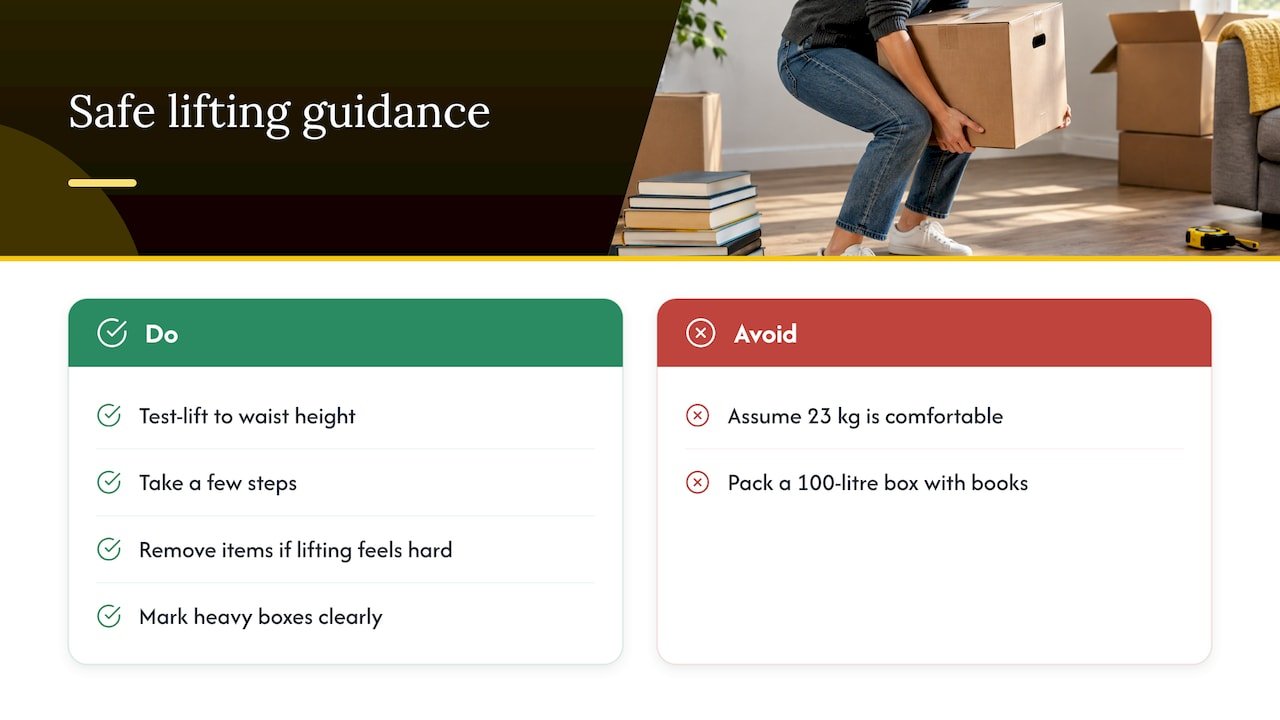
The number printed on a box tells you what fits, not what you can carry. A 100-litre box filled with books would be far too heavy for most people to lift, let alone carry down a flight of stairs.
The guidance used in manual handling is a useful reference point. The NIOSH lifting equation, a US occupational safety method, sets a load constant of 23 kg (51 lb) as the most it recommends lifting under ideal conditions. Real moves are rarely ideal: you are lifting from the floor, twisting at doorways and climbing stairs. So in practice the comfortable weight is lower than that figure.
The practical rule is to let your own strength set the limit. Pack a box, lift it to waist height and take a few steps. If that feels hard, take something out. Mark any heavy box clearly so whoever lifts it knows what to expect.
Heavy things go in small amounts
Irish removal crews give the same advice. Aaltonen’s packing tips sheet says large boxes are for light, bulky items such as duvets, pillows, folded clothes, lampshades and toys, and that heavy items such as books and files do not belong in them. The reason it gives is that the crew must lift boxes long distances and up and down stairs. Lift IT Moving puts it in one line: if you pack heavy, you must pack small.
With a 100L box, that translates into a clear plan:
- Put light bulky items in first: duvets, pillows, towels, cushions, coats, soft toys.
- If you need to pack something dense, such as books or tins, use a single layer on the bottom and fill the rest with soft items.
- Keep fragile items cushioned between layers of clothes or linen.
- Stop filling when you can still lift the box comfortably.
How to work out how many boxes you need
Because our boxes are one standard size, estimating is easier than with a mix of cartons. A rough approach:
- Walk through each room and group items by type: soft and bulky, hard and heavy, fragile.
- Estimate how many 100-litre boxes each group fills. A wardrobe of clothes, for instance, usually fills several boxes if you fold rather than hang.
- Add a few spare boxes for the things you always find late: the cupboard under the stairs, the shed, the attic.
- Choose the package that covers the total. Packages come in 10, 15, 20 and 25 boxes.
For a room-by-room breakdown, our guide on how many boxes you need for moving house goes through a typical home, and our page on choosing your moving boxes shows the options.
Stacking and carrying
Capacity also affects how boxes stack. Equal-sized boxes with lids sit flat on one another, so a van or hallway load stays stable. Put the heaviest boxes at the bottom of a stack and the lightest on top. Our guide to stackable moving boxes covers what to look for and how to build a stable stack.
Carrying is where the moving trolley earns its place. Every package includes one, so you can wheel a stack of boxes to the van instead of carrying each one by hand.
Why renting 100L boxes suits a house move
Cardboard boxes arrive flat, so you have to assemble them and tape them shut. Their strength depends on the grade of board, and they are usually thrown away or left in the hall afterwards. Our reusable plastic boxes are ready to use the moment they arrive. They have secure lids, so there is no tape to buy, and nothing to flatten or recycle at the end.
That suits the readers we hear most from: families packing a whole house over a few weeks, students who need temporary storage between terms, and people who want to move with less waste. Rental periods run from one to four weeks, and delivery and collection are free within our specified areas. For more on cutting waste in a move, see our sustainable moving tips for Irish movers.
Our view on box size
Most people ask about capacity because they want to know how many boxes to order. The more useful question is what they will be able to carry.
We chose one size, 100 litres, because it is big enough to make packing fast and uniform, and the lid keeps whatever you put in it secure. The way to get the best from it is to treat it as a box for bulky, lighter things and to build heavier items in as a base layer.
When every box is the same size, stacking is easier, counting is easier, and you do not spend the evening taping and flattening cardboard. Add the trolley and a one to four week rental, and the move becomes a routine you can plan.
Vincent
Choose your package
Our packages are made for house moves: 10, 15, 20 or 25 reusable 100L boxes with a moving trolley, delivery and collection included within our specified areas, and no assembly or packing tape needed. Pick the size that matches your room count and book your rental period, from one to four weeks.
See the available packages in our shop. If you need storage for an office, we also offer monthly business storage box rental at €5 per month for Small Office, €9 for Office, €16 for Business and €28 for Business Plus.
FAQ
How much weight can a moving box hold?
It depends on the box’s construction, but the figure that matters is what you can lift. Manual handling guidance based on the NIOSH equation uses 23 kg as the ideal maximum, and stairs and awkward corners bring the comfortable weight lower. Lift the packed box to waist height and walk a few steps. If it is hard, remove something.
How many litres is a standard moving box?
There is no single standard. Small book boxes are around 36 to 50 litres, medium boxes around 60 litres, and large boxes from about 96 litres upwards. Our reusable boxes are 100 litres.
What should I pack in a large box?
Light, bulky items: duvets, pillows, clothes, towels, cushions and soft toys. Irish removal crews advise against putting books and files in large boxes because they become too heavy to carry up and down stairs. If you do pack something dense, use one layer at the bottom and fill the rest with soft items.
How do I calculate how many boxes I need?
Group your belongings by room and by type, estimate how many 100-litre boxes each group fills, then add a few spares. Our room-by-room guide gives a starting point for a typical home.
Sources
- How to Measure the Capacity of a Cardboard Box
- Box Volume Calculator: Calculate in cm³, m³, and Liters
- Packing Materials, Lift IT Moving
- Packing Tips Sheet, Aaltonen
- Moving Boxes and Packing Supplies, California Movers USA
Leave a Reply