Most Irish homes need somewhere between 20 and 30 boxes for a studio or one-bed, and 80 to 120 or more for a three-bed, depending on how much you own. The quickest way to get your own figure is to count by room, add a small buffer, and declutter before you pack. This guide shows you how, with worked examples for flats, family homes and student moves.
TL;DR
- A studio or one-bed typically needs about 20 to 30 boxes. A three-bed often needs 80 to 120, based on Irish estimates by home size.
- Count by room instead: roughly 8 to 12 boxes for a lived-in bedroom or living room and 10 to 15 for a kitchen is a sound starting point.
- Add about 10% for last-minute packing, then subtract everything you sell, donate or bin first.
- Uniform, stackable boxes make the count easier to check, because every box is the same size.
- Our 10, 15, 20 and 25 box packages include delivery, collection and a moving trolley.
Table of Contents
- The short answer by home size
- How to count boxes room by room
- What pushes the number up or down
- Declutter first, then count
- Flats, studios and student moves
- Boxes of the same size make counting easier
- Perspective
- Choosing the right package
- Book your boxes
- A simple packing timeline
- FAQ
- Sources
The short answer by home size
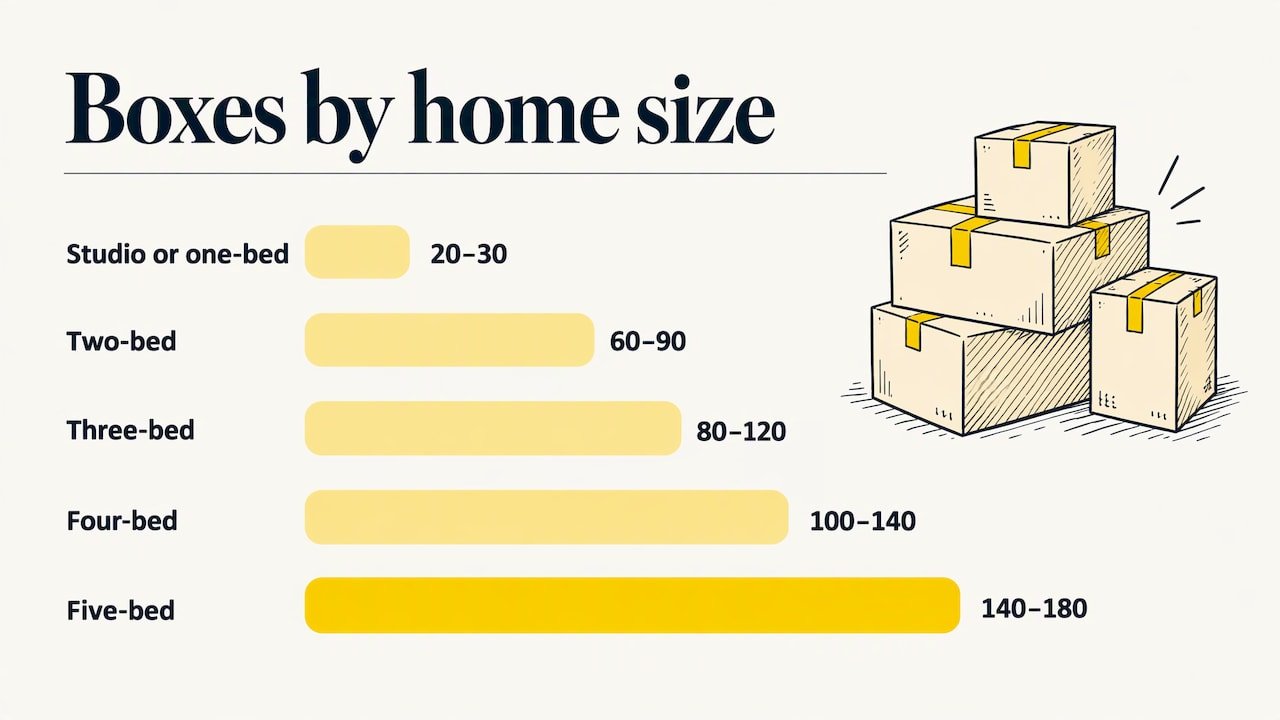
Published estimates vary, and that is normal: a minimalist couple and a family of five can live in the same three-bed. Use the table as a range, then refine it with the room method below.
| Home | Typical number of boxes |
|---|---|
| Studio or one-bed | 20 to 30 |
| Two-bed | 60 to 90 |
| Three-bed | 80 to 120 |
| Four-bed | 100 to 140 |
| Five-bed | 140 to 180 |
These figures come from an Irish estimate by home size, which also advises getting a few extra boxes for last-minute packing. Other guides give lower numbers, especially where they count large cardboard boxes or assume you will move furniture contents in drawers. Treat the range as a ceiling for an average-to-full home and a floor for a very full one.
The gap between a one-bed and a two-bed in that table looks large. It is, because a second bedroom usually brings a wardrobe, a chest of drawers, a second set of bedding and the things that migrate into a spare room. That is why counting rooms beats relying on bedroom numbers alone.
How to count boxes room by room
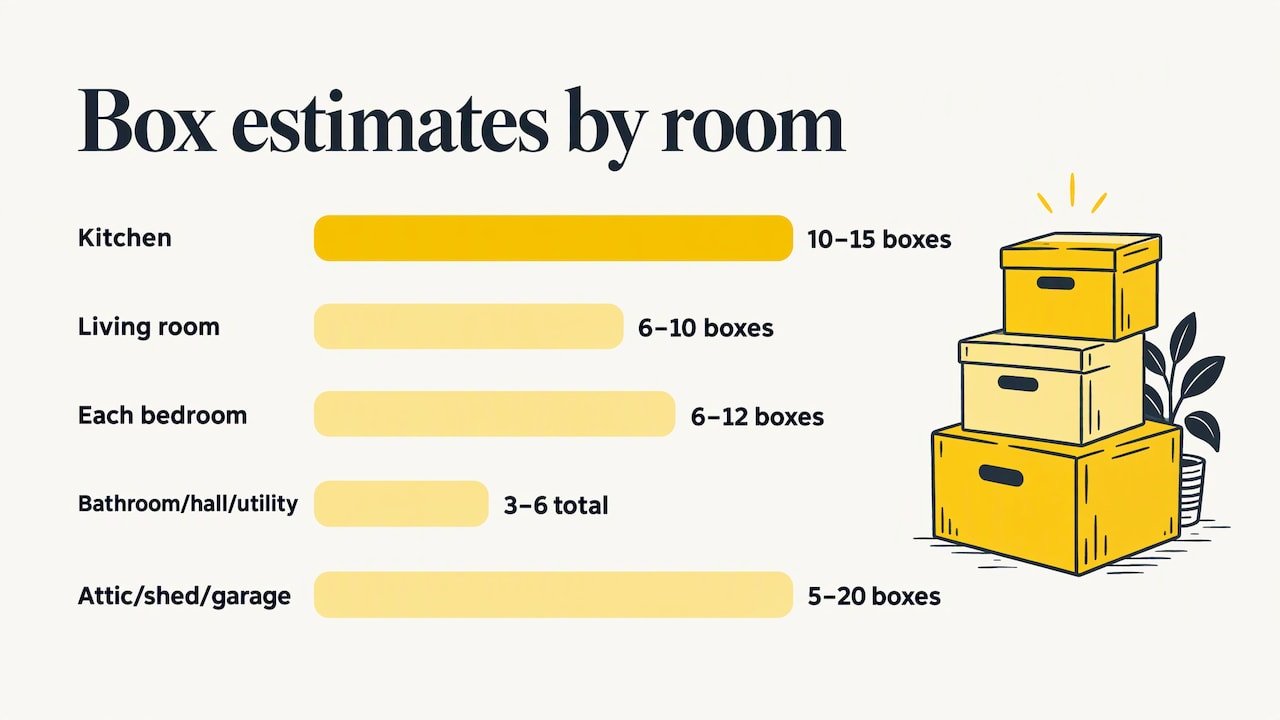
The most reliable method takes about twenty minutes with a notepad. Walk through your home and give each room a box count, using the guide numbers below. They are our own rule of thumb for a standard 50L plastic box, not an industry standard, so adjust them to your belongings.
Kitchen: 10 to 15 boxes
The kitchen is usually the room people underestimate. Plates, glasses, pots, small appliances, tins and spices add up fast. Heavy items like cast iron and crockery suit a smaller box that you can still lift, so do not fill a box to the lid with plates. Spread the weight.
Living room: 6 to 10 boxes
Books, DVDs, ornaments, board games, cables and photo frames. Books are the trap: a few books fill a box and make it heavy, so spread them across several boxes with lighter items on top.
Bedrooms: 6 to 12 boxes each
Clothes on hangers can go in wardrobe boxes or bags, but folded clothes, shoes, bedding and personal items go in standard boxes. A child’s room with toys can hit the top of the range quickly.
Bathroom, hall and utility: 3 to 6 boxes in total
Toiletries, towels, cleaning products, shoes, coats and the contents of the under-stairs cupboard.
Attic, shed and garage: 5 to 20 boxes
This is where the number swings most. Tools, camping gear, Christmas decorations and storage you have not opened since your last move. We come back to these below, because they are also where you can save the most boxes.
A worked example
Take a two-bed house in Cork with a family of three:
- Kitchen: 12
- Living room: 8
- Main bedroom: 8
- Child’s bedroom: 8
- Spare room or office: 6
- Bathroom and hall: 4
- Shed and attic: 8
That is 54 boxes. Add 10% for the things you find at the last minute and you reach about 60, which sits at the lower end of the 60 to 90 range for a two-bed. A fuller household would push towards 90.
What pushes the number up or down
Two households in identical homes can differ by 30 boxes or more. These are the factors that matter.
How long you have lived there. Ten years in a house means ten years of accumulation, much of it out of sight in cupboards and lofts.
Who is moving. Children, hobbies, home offices and collections (books, records, craft supplies) all add boxes. Students and young renters usually sit at the bottom of the range.
What the new place already has. Advice from a Dublin clearance service is to start with the new space rather than the old one: get the floor plan, measure the main rooms, and note what is already there, such as fitted wardrobes, a built-in kitchen or appliances. If the new kitchen has everything, you may not need to pack the old appliances at all.
Large furniture decisions. The same source points out that the real question is not whether you still want something, but whether it will fit and be used in the new home. A wardrobe or sofa that will not go through the new doors is better dealt with before moving day. Every piece you let go also frees the boxes that would have packed its contents.
Whether you declutter first. This is the biggest lever you control, and it is covered next.
Declutter first, then count
Counting boxes for things you will not keep is the most common reason people over-order. Declutter before you do the count, not after.
A few approaches that work:
- Use the same four piles in every room: keep, give or sell, recycle, let go. One Irish clear-out guide recommends finishing one room before starting the next so the process does not stall, and checking every pocket, drawer and box before it is bagged.
- Start with the forgotten spaces. Another Irish guide advises clearing the attic, shed and garage first because they are the most forgotten and dustiest, and notes that decluttering early reduces both the number of boxes and the weight you carry.
- Set a deadline. Aim to finish decluttering at least two weeks before the move so your count is firm when you book boxes.
Once the piles are sorted, recount. Many people find the total drops by a fifth or more.
Flats, studios and student moves
Smaller moves are simpler to estimate. A studio or one-bed flat normally lands in the 20 to 30 box range. A guide on what fits in a van says a large panel van usually takes the contents of a studio or one-bed flat in a single load, with room for a bed, wardrobe, sofa, table and chairs, plus around 20 to 30 boxes. It adds that a student move is one load, and a two-bed flat is one or two loads.
For students, the practical points are:
- Count 8 to 15 boxes for clothes, books, kitchen basics and electronics.
- If you are going home for summer, you may only need boxes for the stuff you are leaving behind, so count that separately.
- A short rental period suits term-time moves, since you will not want boxes sitting in a small room for weeks.
A one-week rental is usually enough for a flat move: a couple of days to pack, the move itself, and a few days to unpack before collection.
Boxes of the same size make counting easier
Cardboard boxes come in small, medium, large and extra-large, and guides disagree on the best mix. One popular split is 20 to 30 small, 15 to 20 medium and 10 to 15 large for a large home. That makes planning harder, because you have to guess how much each room needs in each size.
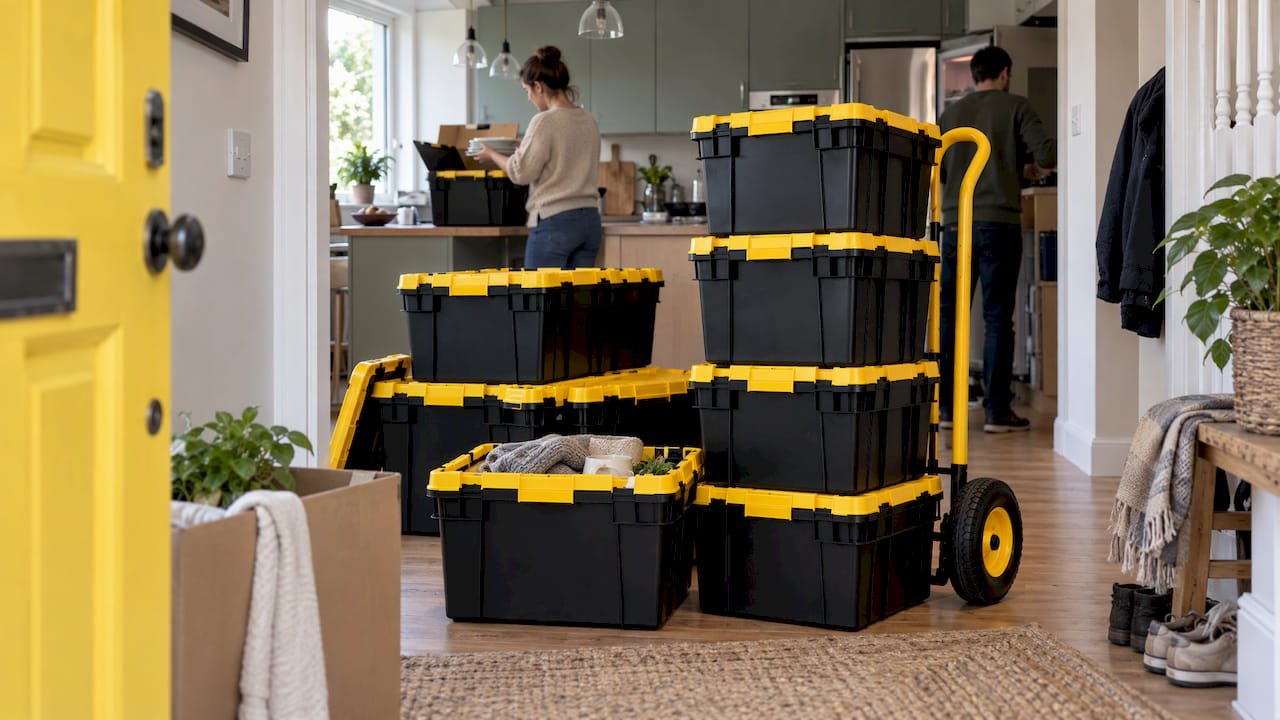
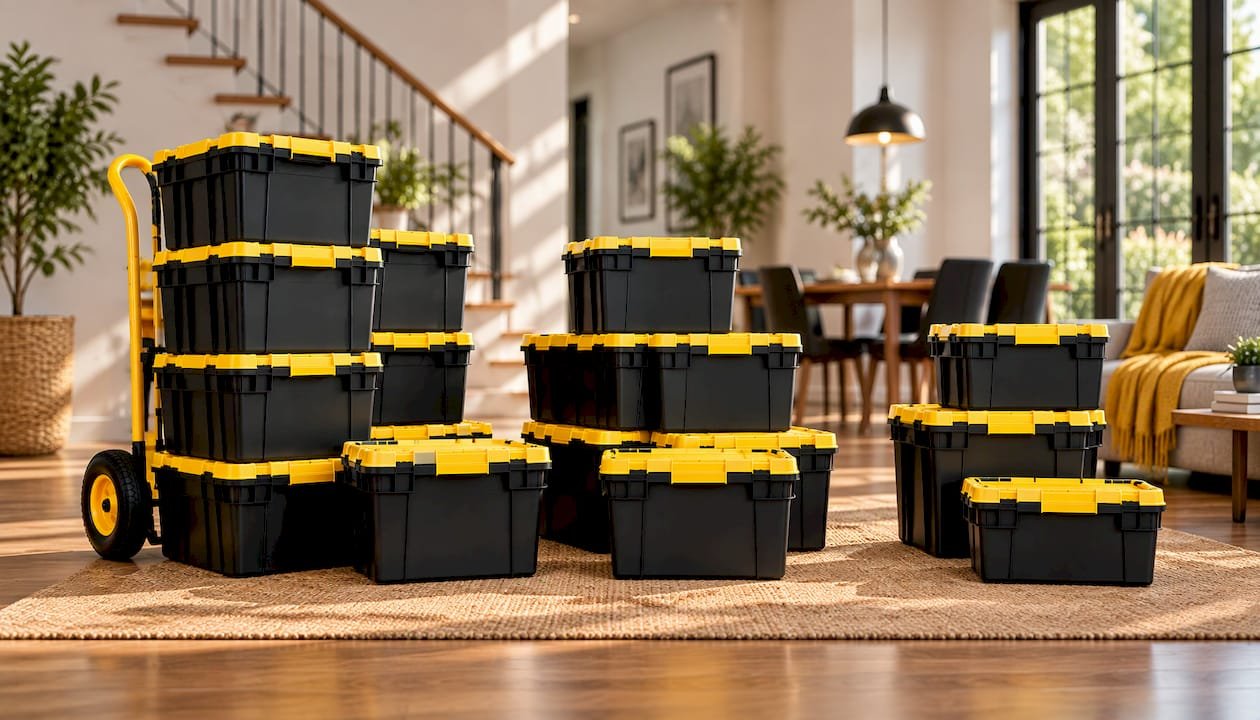
With a single standard size, the sum is simpler. Our boxes are 50L reusable plastic boxes with secure lids, so every box holds the same volume and stacks the same way. You count rooms, add them up, and pick the package that covers the total. There is also nothing to assemble and no tape to buy, so you will not discover halfway through that you are one roll short.
Plastic boxes are also designed for repeated use. An Irish removals blog notes that plastic boxes can be reused many times while cardboard may tear after one use, and that they are easy to stack and carry thanks to built-in handles.
Perspective
Every month we hear the same worry: “I have no idea how many boxes I need, so I’ll order too many.” Our advice is to stop guessing at the whole house and start with one room.
Pack the kitchen first, because it is the hardest room and teaches you most. See how many of our 50L boxes it takes, and multiply that lesson across the rest of the house. Most people are surprised by how quickly the number becomes clear.
We built our packages around this. A set of ready-to-use boxes with lids, delivered to your door, with a moving trolley included, means you spend your time packing and not assembling, taping or breaking down cardboard afterwards. When you are finished, we collect the boxes, so there is nothing to recycle or store.
Choose a package a little above your estimate rather than exactly on it. A few spare boxes cost far less stress than a missing one on the last evening.
Vincent
Choosing the right package
We offer four package sizes: 10, 15, 20 and 25 boxes. Every package includes delivery, collection and a moving trolley, and rental periods run from one to four weeks. Use this as a starting guide:
| Your move | Likely boxes | Where to start |
|---|---|---|
| Student room or bedsit | 10 to 15 | 10 box package or 15 box package |
| Studio or one-bed flat | 20 to 30 | 20 box package or 25 box package |
| Larger homes | 60 and above | Get in touch through the shop page to talk through your count |
The price for each package is listed on its product page. Delivery and collection are free within our specified areas, so check yours when you book.
How long to rent for
A week is enough for a small flat. For a family home, packing room by room over two to three weeks is more realistic, especially if you are decluttering at the same time. Four weeks gives you room to unpack at the other end before we collect.
Book your boxes
Once you have your count, you can pick a package in a few minutes. Our reusable 50L boxes arrive ready to use, with lids, and we collect them when you are done. See all four sizes on our moving box rental shop and choose the one that matches your estimate.
If you are looking for storage for an office rather than a house move, we also rent boxes monthly to businesses. Plans are €5 per month for Small Office, €9 for Office, €16 for Business and €28 for Business Plus.
A simple packing timeline
Knowing your number is half the job. The other half is not running out of time.
- Four to six weeks before: declutter the attic, shed and garage. Sell or donate what you can.
- Three weeks before: finish the other rooms, one at a time. Do your room-by-room count and book your boxes.
- Two weeks before: pack things you rarely use: books, off-season clothes, decorations, spare bedding.
- One week before: pack the living room and spare rooms. Label each box with its room and a short list of contents.
- Final days: pack the kitchen, bathroom and bedrooms, keeping an essentials box with kettle, mugs, chargers, toiletries and a change of clothes.
- Moving day: use the trolley for heavy loads, stack boxes by room in the new home and unpack the essentials first.
Label the side of each box, not the lid, because lids are hidden once stacked.
FAQ
How many boxes do I need for a three-bedroom house?
Most three-bed homes need between 80 and 120 boxes according to Irish estimates by home size. A tidy household that has decluttered may need far fewer, and a family with children and a full attic may need more. Count room by room, add 10%, and then adjust.
How many boxes do I need for a one-bed flat?
Usually 20 to 30. A van guide says a studio or one-bed flat with around 20 to 30 boxes is typically a single van load. Our 20 and 25 box packages cover that range.
Should I order extra boxes?
Yes, a small buffer of about 10% is sensible. Last-minute items always appear, and the Irish estimate by home size also recommends a few extra boxes. If you end up with spare ones, you simply return them at collection.
Is it better to use plastic boxes or cardboard?
Plastic boxes are built for repeated use, stack easily and have built-in handles, with no assembly or tape. Our 50L boxes have secure lids, and we deliver and collect them, so you are not left with a pile of flattened cardboard after the move.
How long should I rent boxes for?
One week suits a small flat or student move. A family home usually needs two to three weeks to pack and unpack calmly. Our rental periods run from one to four weeks, so you can match the time to the size of your move.
Sources
- Moving boxes estimates by home size, GetAMover
- What fits in a man with a van, WeHaul
- Moving house in Dublin: what to clear before the removal, HouseClearances.ie
- Room-by-room house clear-out guide, Spotless.ie
- Packing for a house move in Ireland, ShamFix
- Should you rent plastic moving boxes or cardboard boxes, VanMan.ie
Leave a Reply